.png)

Every generation convinces itself its technology is the exception. Today it's AI: too fast-moving, too powerful, too different from anything that came before to follow the old rules. History says otherwise. This isn’t to say that we believe AI isn’t a truly transformative technology, nor faster moving than a lot of the prior cycles. We actually do. However, folks sometimes underestimate how technology platforms follow a remarkably consistent arc, and AI is showing every sign of following the same path.
Just look at the world of compute, for example. First, the compute landscape evolved from monolithic mainframes to a diverse ecosystem of Linux, Windows, and macOS offerings. Then, single-vendor database architectures gave way to a wide range of specialized data engines (open-source, SQL, NoSQL, vector databases). Along the way, cloud offerings have splintered into a wide variety of specialized capabilities, certifications, and pricing tiers that no single vendor controls. I watched this play out firsthand at VMware, where this fragmentation created entire startup categories: cloud cost optimization, cloud security posture management, and others that didn't exist a decade earlier.
AI models are now undergoing the same transition. Large versus small, expensive versus cheap, open versus closed, general versus specialized, even splitting by country and region. The pattern holds up - diversity of choice creates new problems, which creates new infrastructure, which creates solutions that pull further and further away from the idea of one model to rule them all.
Today's ecosystem spans a continuum across open-weights and closed-source, varying parameter sizes (from edge models to mega-scale reasoning models), and distinct optimization targets across latency, context window, and cost. This explosion in model diversity enables classic engineering trade-offs: balancing accuracy, latency, throughput, and compute unit economics. For today's AI startups, including several that we're working on at Juxtapose, this fragmentation yields interesting opportunities. We see this fragmentation as a map, showing us where the surface area for building the control plane has widened. History has shown us that the companies that own these planes capture far more durable value than the ones duking it out in the layer beneath them.
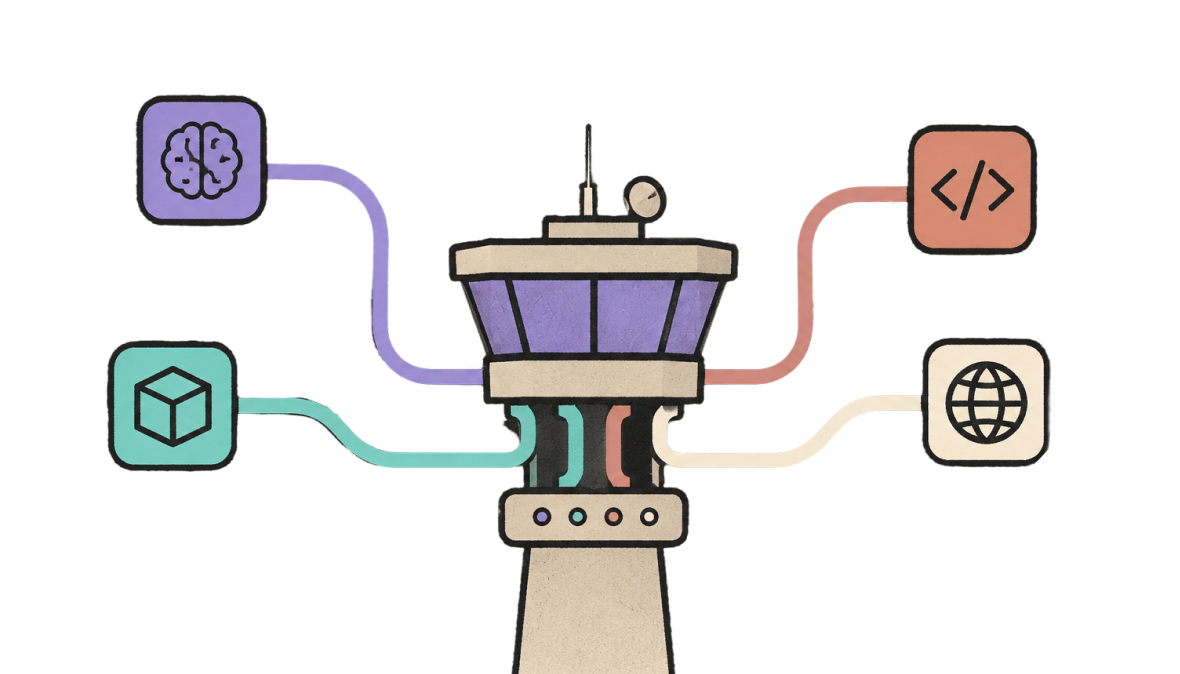
Dynamic Model Routing
Building AI systems today is an architecture problem, not just a single API integration problem. Winning applications rarely route every request to a top-tier frontier model. Instead, they employ multi-model orchestration, hybrid retrieval-generation setups, and cascade routing. And the results can be game-changing.
Routing routine tasks (intent classification, basic formatting, initial filtering) to small, highly optimized open models reduces inference costs by orders of magnitude while preserving low latency. Complex, multi-step reasoning can then be conditionally escalated to state-of-the-art closed models. In a nice bit of “meta”, we leverage large frontier models to generate synthetic domain data and supervise optimization of smaller models via distillation, achieving near-frontier accuracy on narrow enterprise tasks at a fraction of the serving cost. We've seen dynamic routing arise time and time again. One example is content delivery networks (CDNs). Before companies like Akamai, one of the first true control plane businesses valued today at $15B+, every web page request hit the origin server - and this was expensive, slow, and centralized. Edge caching pushed the 80% of requests that were repetitive or predictable out to cheaper, fast, distributed nodes, and only escalated cache misses or dynamic content back to origin. The same will hold for AI model selection - cheap local handling of the routine case, expensive centralized models reserved for what can't be served locally.
Observability
The other opportunity arises from a need to tame the chaos, something we've seen throughout every evolution of enterprise infrastructure. As enterprises deploy dozens of models across fragmented providers, the burden of governance, observability, and compliance becomes a primary bottleneck to production deployment. This is required to achieve the full potential of AI, and it's a massive opportunity for infrastructure startups.
Enterprise IT needs model-agnostic tools for all the traditional areas within their domain: governance, risk management, compliance, and security-related policy enforcement - all of which start with observability. This gets even harder in the AI world, with a need for guardrailing inputs and outputs, mitigating PII leakage, and auditing model bias across heterogeneous LLM vendors and model drift. As if this weren't hard enough, they also need new types of observability: modern stacks demand cross-model monitoring for drift, cost, latency, and effectiveness.
This evolution mirrors telemetry in distributed microservice architecture. Billion-dollar companies such as Datadog, New Relic, Chronosphere, Dynatrace, Splunk, and SignalFX arose to provide this visibility and advance the acceptability of this new technology. The stellar team at Juxtapose portfolio company Lanai is taking on a critical part of this daunting task, providing visibility into every AI workflow with an eye toward ROI analysis.
The Engineering Challenge: Model Selection at Scale
At its core, model selection is a high-dimensional optimization problem: mapping tasks to the minimal required compute budget without sacrificing fidelity. Solving this reliably across dynamic workloads requires sophisticated algorithmic routing, context management, and continuous benchmark evaluation.
At Juxtapose, we view this shift as a fundamental turning point and a great opportunity. Prior cycles taught us that the control plane opportunity opens before the fragmentation feels settled, and the winners sell an abstraction that survives the next round of fragmentation rather than solely fixing the current one. We’ve also learned that one of the hardest parts of building these technologies is knowing which version of your solution a CIO will actually buy. Our longstanding Enterprise IT focus, coupled with a rich ecosystem of partners, advisors, and prospective customers, has set Juxtapose up to move quickly and build in a more targeted way, with customers informing the product from day one.
Our team is building products that actively capitalize on both sides of this equation: intelligent systems that leverage the right model for the job at hand, and the underlying coordination, optimization, and governance tooling required to make multi-model architectures secure, predictable, and enterprise-ready. As model diversity accelerates, the value in AI will not belong solely to those who train the largest weights, but to the architectures that tame their complexity. It's a fun time to build!
Steve Herrod is a partner at Juxtapose focused on enterprise software builds.