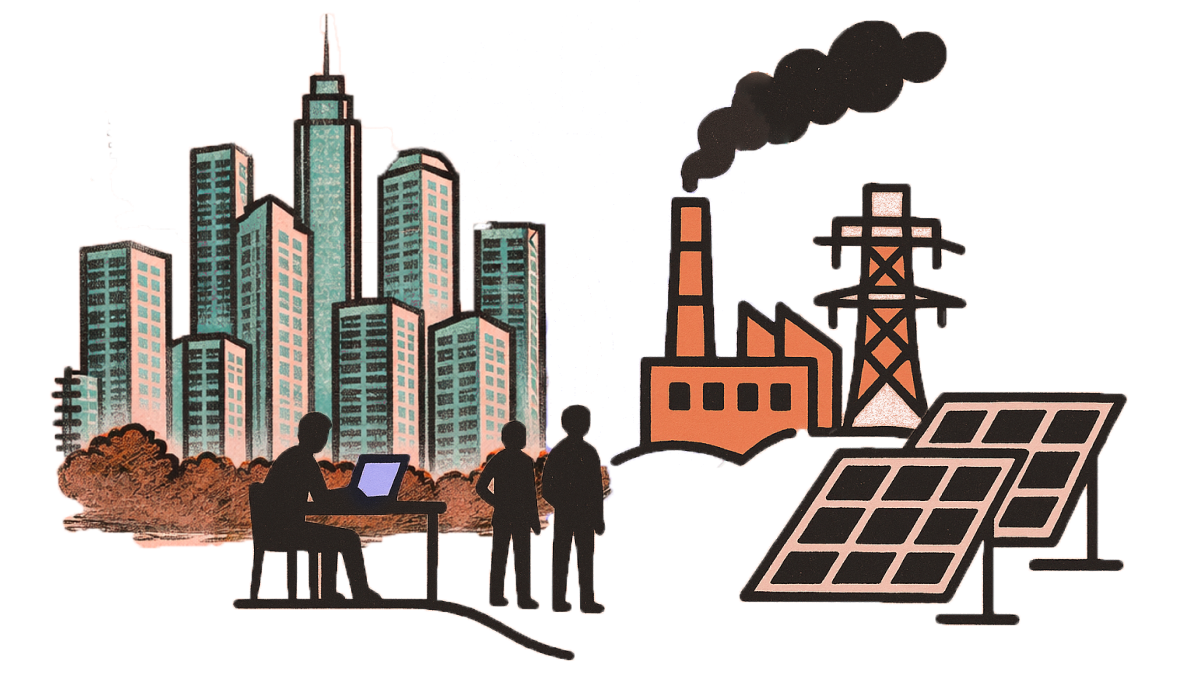
For nearly three decades, technology innovation has been defined by software abstraction, like digitizing workflows, removing friction from consumer experiences, and making the administrative side of business faster and lighter. Entire categories were built on the idea that progress meant making the physical world disappear behind interfaces, and that value lived on our screens. Today, that paradigm is shifting.
Where Web 1.0 wired the economy and Web 2.0 layered software on top of it, the AI era is rebuilding industries from the inside out by embedding intelligence directly into machines, workforces, and physical systems. This is more than another app cycle. It’s an (industrial) revolution.
From Wiring → Abstraction → Intelligence
Web 1.0 connected the world. It standardized data and communications across defense, logistics, telecom, and industrial IT. The defining companies of that era, including Cisco, Intel, SAP, Oracle, and Microsoft, sold infrastructure. It accelerated what already existed, but it didn’t fundamentally change how industries worked.
Web 2.0 went a step further. Cloud computing, mobile devices, APIs, and marketplaces radically lowered the cost of building and distributing software. A new generation of businesses flourished in sectors where bottlenecks were primarily digital: commerce, media, payments, sales and marketing, labor marketplaces. Companies like Amazon, Shopify, Netflix, Stripe, Salesforce, and Uber abstracted complexity away from the physical world. They transformed how people interacted with products and services, but not how the underlying physical operations worked.
The sectors that were too physical, too regulated, too operationally complex, or too dependent on human judgment were left largely untouched. Those sectors are now becoming the center of gravity.
The AI Industrialization Wave
AI marks the third wave of technological enablement, and it is fundamentally different from the first two. It is not merely generating content or analyzing text. For the first time, AI is making physical operations programmable.
This shows up first in industrial data infrastructure. Web 1.0 digitized data; AI is now activating it. Intelligence is being layered onto operating systems that can predict equipment failure and trigger remediation, scale sales and support through automated follow-up, identify system-wide bottlenecks and dynamically improve throughput, and coordinate digital and analog networks in real time. Industrial operations are no longer static systems optimized through periodic human intervention. They are becoming adaptive systems that learn continuously.
AI is also reversing a 20 year bias toward asset-light business models. Where Web 2.0 rewarded abstraction, AI rewards integration. Robotics, intelligent sensors, edge devices, and autonomous equipment create compounding feedback loops in which physical interaction generates proprietary data, and that data improves physical performance. The physical–digital interface is no longer a margin drag. It is a moat.
Perhaps most consequential is AI’s conversion of labor-intensive services into repeatable, software-driven workflows. Between field service automation, maintenance and inspection intelligence, contractor and vendor orchestration, operations outsourcing, and embedded fintech tied directly to asset performance, AI is doing for heavy industry what SaaS once did for white-collar work. Variability is collapsing, margins are expanding, and scale is accelerating.
The Broader Market Is Moving This Way, But Incompletely
Over the past 24 months, leading venture firms have reoriented toward this physical–digital frontier:
- OpenAI x Thrive announced a formal partnership to build next-generation industrial and services companies focused on building AI-native platforms via consolidation and deep operational integration
- General Catalyst is pursuing a similar model through its Resilience and Creation initiatives — emphasizing system-level solutions, not standalone applications.
- Teamshares is demonstrating the power of programmatic acquisition and software enablement to scale real-economy businesses.
- a16z, via their American Dynamism effort, has been playing on the frontier of physical real-world meets technology (including now, specifically AI) for several years now.
- And Y Combinator is now explicitly calling for “full-stack AI companies” — businesses that own operations, distribution, data, and workflow loops, not just the application layer.
Taken together, these moves point to a macro insight that many leading venture investors and builders are betting on: the value in AI will accrue to companies that control real workflows, real assets, and real data — not just those sitting at the thin application layer.
Why Creation-Oriented Investing Has a Structural Advantage
Juxtapose’s inception-stage company building model, which combines creation, acquisition, operational integration, and modern software, was designed for exactly this moment. We build full-stack companies from the ground up, integrating software with operations and physical assets so that proprietary data loops emerge defensibly. We partner deeply with domain operators like CEOs and industry leaders with decades of hard-won expertise because we believe AI should amplify judgment, not replace it. We endeavor to de-risk category creation through acquisition and vertical integration, gaining immediate access to the raw material of AI advantage: workflows, customers, and data. And we focus on moat-rich industries with enduring demand, like skilled trades, field services, specialized equipment, power generation, and risk-heavy sectors where aging expertise is meeting a digital interface for the first time. We believe that the convergence of physical assets and intelligence will compound advantage over time.
Proof in Practice
Zephyr, our AI-enabled HVAC services platform, uses AI to power virtual sales tools that materially increase installation conversion. Training systems accelerate technician upskilling across a distributed workforce, collapsing variability. Operational analytics continuously improve scheduling, routing, capacity allocation, and install quality.
Rux, meanwhile, is building the operating system for the $60B+ specialized equipment category. Predictive maintenance, utilization insights, automated rental and service workflows, and data-driven repair operations are turning a fragmented, analog industry into a coordinated, software-enabled network. What once functioned as disconnected local markets is becoming an intelligent platform.
These companies are examples of what it looks like to define an industry shift, not just respond to it.
Why This Moment Is So Fertile for Full-Stack AI Platforms
We’re excited by the opportunities that exist for inception-stage firms to take advantage of this paradigm shift. Three secular forces in particular are converging in a way that has been driving thinking on opportunities for Juxtapose:
1. Electrification & Grid Upgrades. The U.S. is undergoing the largest infrastructure transformation since the postwar era across EVs, heat pumps, microgrids, and distributed energy. This creates enormous demand for industrial coordination, workforce expansion, and system intelligence.
2. The Aging Technical Workforce. Across HVAC, electrical, plumbing, manufacturing, and industrial services, a generational skills gap is emerging. AI-enabled training, remote supervision, and workflow automation will be required just to maintain capacity.
3. Generational Expectations of Work. Younger workers demand modern tools like a hybrid office environment with seamless collaboration, AI copilots and mobile-first workflows, and technology-enablement across the enterprise with an intuitive UI/UX. We believe that industrial employers who lag here will lose talent while those who modernize will win a disproportionate share of their markets.
Together, we believe these forces represent a once-in-a-generation opportunity to build the next great industrial platforms.
This Era Will Reward Builders of Systems, Not Apps
The first AI boom created thousands of application-layer tools that looked compelling, but many lacked long-term defensibility: no proprietary data, limited distribution, low switching costs, and no access to real workflows. We believe that the next era will reward companies that own the full stack:
- Software + hardware + operations
- Privileged data loops
- Embedded intelligence
- Recurring workflows tied to mission-critical outcomes
This is the architecture we are compelled by here at Juxtapose. As AI moves from screens into the physical fabric of the economy, the companies that matter will be the ones that reshape industries, not the ones that sit above them. We look forward to building them.
This essay by Geoff Miller originally appeared in the December 2025 issue of Juxtapose's newsletter, Inception Point.